

Pip & Wells Journal · 6 min read
There is a moment every new diffuser owner knows. The device is out of the box, the oil is in, the thing is running. It smells good — better than good, actually. And then, sometime in the first week, a practical thought arrives uninvited: how long is this actually going to last?
It is a fair question. One that most retailers prefer to answer with words like "long-lasting" or "depending on use" — phrases that technically mean something and practically mean nothing. Here is the honest version.
The Number You Are Looking For
A 120 ml bottle of Pip & Wells fragrance oil lasts six to ten weeks in regular home use. For someone running their diffuser one to two hours an evening in a standard living room, eight weeks is the realistic middle of that range. The precise outcome depends on five factors — all of them within your control, none of them complicated.
Five Factors That Determine How Long Each Bottle Lasts
How many hours a day you run the diffuser
This is the single largest variable, and the maths is direct: two hours a day uses roughly a quarter of the oil that eight hours a day consumes. What is less obvious is that the longer option does not actually give you more. Your nose adapts to a constant scent within thirty to sixty minutes of exposure — a phenomenon called olfactory adaptation — meaning the person who runs their diffuser continuously stops experiencing the fragrance long before the session ends. Short, deliberate sessions deliver more enjoyment per millilitre than continuous running ever will.
What intensity setting you use
The Pure One has adjustable output. At maximum intensity, it consumes oil at roughly two to three times the rate of the lowest setting. For most living rooms and bedrooms, low to medium is more than sufficient to fill the space with a full, even scent. High is rarely necessary — and when it feels necessary, the cause is almost always diffuser placement rather than output.
The size of the room
A fifteen square metre bedroom requires considerably less fragrance to feel properly scented than a sixty square metre open-plan kitchen and living area. Larger spaces may need slightly more output or longer sessions to reach the same ambient level — both of which reduce bottle life. The Pure One is designed to cover up to 75 m², so within that range there is no need to push intensity simply to reach the far end of the room.
How well ventilated the space is
Open windows, active heating and cooling systems, and doors that open and close frequently all disperse fragrance more rapidly than a sealed room would. The same intensity setting delivers noticeably more scent in a well-sealed space than in one that is constantly ventilated. If the fragrance seems to fade faster than expected, ventilation is almost always the cause — and the solution is to close a door or window rather than turn up the diffuser.
How strong you like the scent
Some people prefer a fragrance so subtle it barely registers consciously — present as atmosphere rather than as smell. Others want to notice it the moment they walk through the door. Both preferences are completely valid. The difference in oil consumption between those two approaches, over the course of a full bottle, amounts to two or three weeks. Restraint, as with most things in a well-considered home, pays off.
What This Looks Like in Practice
To make the range concrete: running the diffuser two hours each evening on a low setting in a 25 m² living room will comfortably stretch a bottle to ten to twelve weeks. Running it eight hours a day on medium in a 50 m² open-plan space lands at five to six weeks. Running on maximum for ten or more hours a day in the largest room the device can handle will exhaust the bottle in three to four weeks.
Most people sit somewhere between the first and second scenario. In practice, that comes to roughly one bottle every two months per room — and that is the unit most worth planning around.
Why Cold-Air Diffusers Are More Economical Than They Appear
There is a persistent assumption that a waterless diffuser burns through oil faster than an ultrasonic one, precisely because the oil is undiluted. The reality runs in the opposite direction.
An ultrasonic diffuser disperses oil through evaporation from a water surface. A significant portion of the fragrance is lost to that evaporation process before it ever reaches the air as perceivable scent. Users compensate without realising — more drops per tank, longer sessions, and still a weaker result. It costs more and delivers less than the numbers suggest.
A cold-air nebulising diffuser atomises the oil directly and precisely into the air. Every drop becomes fragrance. Nothing is sacrificed to a water tank. In practice, a 120 ml bottle in a cold-air device outlasts the same volume in an ultrasonic one — while delivering a noticeably fuller and more accurate scent profile throughout. The full comparison between the two technologies is in our article on waterless versus ultrasonic diffusers.
Four Habits That Extend Every Bottle
Run with intention, not continuously
There is no benefit to a diffuser running all day in a room you are not using. A one to two hour session in the evening delivers the full ambient experience — and because your nose has not yet adapted, you actually experience it. Continuous running costs more and registers less. The diffuser is more effective, and more economical, when it is treated as something you switch on deliberately rather than leave running in the background.
Start lower than you think you need
The impulse when setting up a new diffuser is to run it on high for immediate impact. This almost always leads to overconsumption without a meaningful improvement in experience. Most rooms are fully scented on low or medium. Start there. If the fragrance genuinely feels insufficient after thirty minutes, increase by one step. You will find the right level faster than you expect — and use considerably less oil getting there.
Close the room during the session
If you want to scent the living room, close the door to the hallway. The fragrance will stay where you put it rather than gradually dispersing throughout the house. In an open-plan home where kitchen, dining, and living areas are connected, this matters less — but any adjacent space that is not part of your intention is worth closing off.
Store bottles away from heat and light
Fragrance oils oxidise faster when exposed to warmth and direct sunlight. A bottle sitting on a sunny shelf next to the diffuser will degrade faster than one stored in a cupboard. Keep unused bottles somewhere cool and dark. Screw the cap firmly after every refill. Small habits, meaningful results over the life of a bottle.
Frequently Asked Questions
How long does a 120 ml fragrance oil last in a cold-air diffuser?
At one to two hours of use per evening, low to medium intensity, in a standard living room: seven to ten weeks. The most important variable is how many hours a day the diffuser runs — everything else is secondary.
Does fragrance oil expire?
Properly stored, fragrance oil remains stable for two to three years from manufacture. Heat, direct sunlight, and prolonged exposure to air all accelerate degradation. Once opened, use within twelve months for the best scent fidelity. An oxidised oil smells flat or subtly off compared to when the bottle was first opened — at that point, replacing it is better than persisting with it.
Why is my oil running out faster than expected?
Almost always one of three causes: intensity set too high, more daily usage hours than estimated, or a room larger than the device's optimal range. Dropping intensity by one step or shortening daily session length typically restores expected bottle life without any noticeable reduction in the ambient scent experience.
Is it worth buying multiple bottles at once?
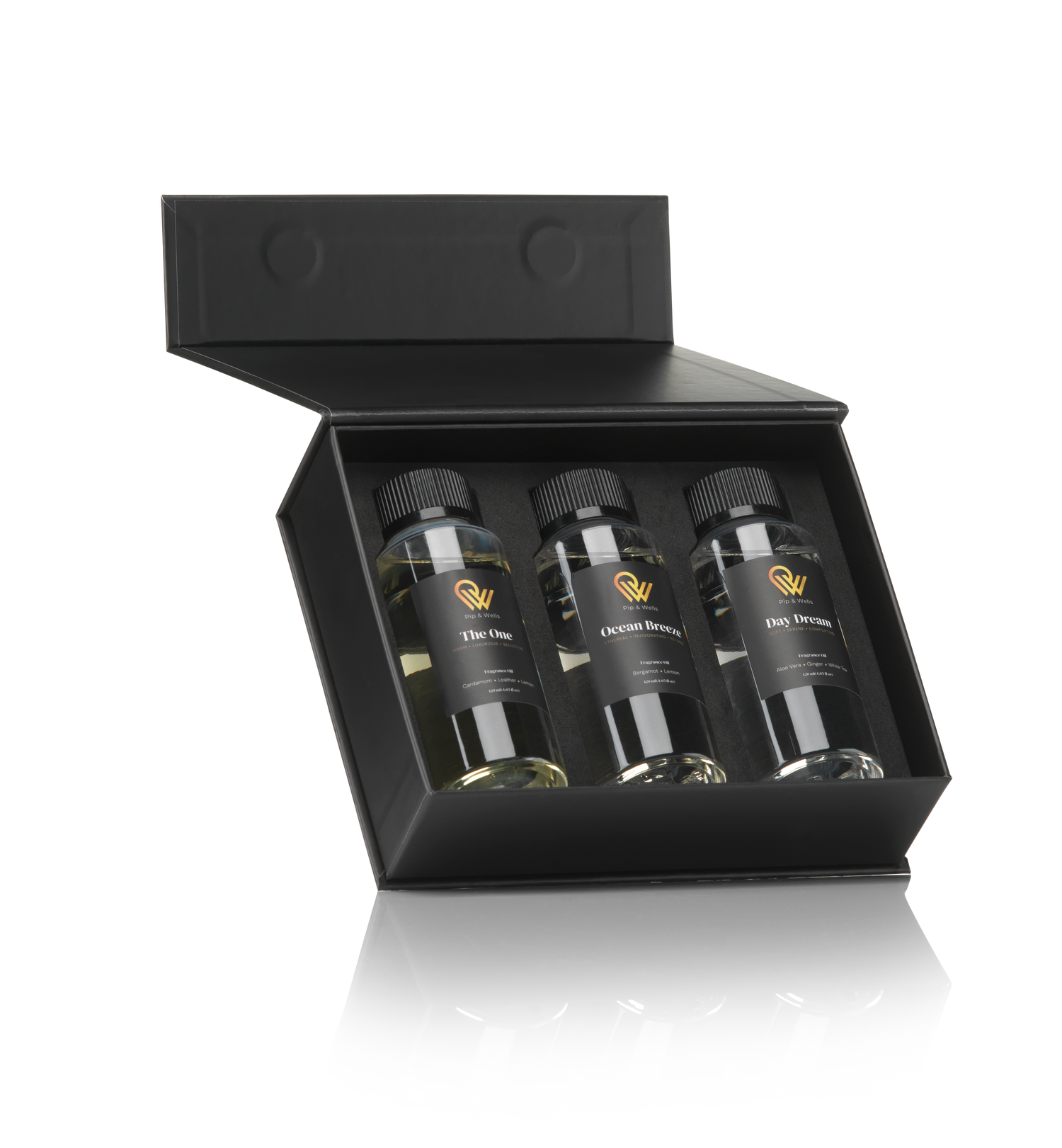
Yes. The Pure One Giftbox includes three 120 ml fragrance oils alongside the diffuser, at better value per bottle than buying individually. Keeping a spare bottle on hand means your home's scent never has a gap — and that continuity is precisely what makes the experience accumulate over time.
Can I mix two fragrance oils together?
We do not recommend it. Each oil is a complete, coherent composition. Combining two creates an uncontrolled result that reflects the intention of neither. If you want to explore multiple scents, rotate between them on different days rather than blending them in the device.
Does using the diffuser on a timer extend bottle life?
Considerably. Running on timed intervals — thirty minutes on, thirty minutes off — rather than continuously can extend bottle life by thirty to fifty percent. The fragrance lingers in the room between cycles, so the ambient level barely drops while the oil consumption drops significantly. It is one of the simplest changes with the largest practical effect.
Related: Waterless vs. Ultrasonic Diffuser: The Real Difference · Is a Waterless Diffuser Safe for Kids and Pets? · How to Make Your Home Smell Like a Hotel
Leave a comment
This site is protected by hCaptcha and the hCaptcha Privacy Policy and Terms of Service apply.