

Pip & Wells Journal · Buying Guide · 8 min read
You have decided you want a diffuser. That part is easy. Now you are facing a choice that most retailers gloss over — and one that will determine whether you end up with something that genuinely transforms your home, or a device that quietly disappoints you after a few weeks.
The market is dominated by two technologies: ultrasonic (water-based) and waterless cold-air (nebulising). They cost roughly the same. They both put scent into the air. But they work on entirely different principles, and the difference in result is not subtle.
This guide covers exactly how each works, what the real trade-offs are, and which one is worth your money.
How an Ultrasonic Diffuser Works
Ultrasonic diffusers are the most widely sold type — available in every homeware shop and on every online marketplace. The principle is simple: fill a water reservoir, add a few drops of fragrance or essential oil, and use high-frequency vibration to break the mixture into a fine visible mist that rises into the air.
The mist you see is mostly water. The fragrance travels along with it.
These devices are popular because they are cheap to produce, visually appealing with their mist effect, and can double as light humidifiers. For basic use in a small room, they do what they say. But for actual fragrance performance — the kind that makes a room smell genuinely good — they come with serious limitations.
How a Waterless Cold-Air Diffuser Works
A waterless cold-air diffuser — also called a nebulising diffuser — works on a fundamentally different principle. Instead of water, it uses pressurised air to atomise pure fragrance oil directly into ultra-fine dry particles. No heat. No water. No visible mist.
The result is invisible fragrance distributed evenly throughout the room. The scent you smell is the fragrance oil as it was composed — not diluted, not heat-altered, not reduced to whatever survived the journey through a water tank.
This is the technology used in luxury hotels, high-end spas, and premium retail environments worldwide. The reason is simple: it is the only method that delivers consistent, full-spectrum fragrance across a large space. The Pure One Diffuser by Pip & Wells uses this same technology, covering up to 100 m².
The Real Differences — Side by Side
| Criterion | Ultrasonic (Water-Based) | Waterless Cold-Air |
|---|---|---|
| Scent quality | Diluted by water. Top notes often lost. | Full-strength. Complete fragrance profile preserved. |
| Coverage | Typically 15–25 m² effectively | Up to 100 m² with even distribution |
| Consistency | Fades as water evaporates | Consistent throughout the session |
| Maintenance | Daily water refill + weekly tank cleaning | Refill the oil bottle — nothing else |
| Mould risk | Real — standing water needs regular hygiene | None — no water involved |
| Surface residue | Can leave water marks on wood and electronics | None — dry diffusion |
| Noise | Quiet hum, occasional water sounds | Near-silent on low and medium settings |
| Oil economy | Less efficient — more oil needed per session | More efficient — every drop becomes fragrance |
Where Ultrasonic Diffusers Fall Short
Water dilutes the fragrance
This is the fundamental problem. A fragrance oil is designed to be experienced at full concentration. When you add a few drops to a tank of water, you have diluted it significantly before it even reaches the air. The complex top notes — the delicate, refined elements that make a quality fragrance feel expensive — are usually the first to be lost. What fills the room is a flattened, generic version of the scent. It smells pleasant near the device and vague everywhere else.
Mould and bacteria are a real concern
Standing water combined with organic compounds and warmth creates conditions for microbial growth within 24 to 48 hours if the tank is not cleaned regularly. Most people do not clean their ultrasonic diffuser tank every week. Over time, the device can silently become a source of things you do not want dispersed into the air you breathe — particularly a problem for people with allergies or respiratory sensitivity.
Coverage is genuinely limited
Because the fragrance is carried by water droplets, gravity does most of the distribution work. The mist settles near the device. Three or four metres away, the scent thins out rapidly. You end up perfuming the corner of the room where the diffuser sits, while the rest of the space remains neutral.
The visible mist becomes visually dated
The mist effect looks appealing in product photos. In a considered interior, the plastic reservoir and rising vapour read more as appliance than design object. This is subjective, but worth noting if you have invested thought into how your home looks.
Where Cold-Air Diffusers Excel
You smell what the fragrance was designed to smell like
Because the fragrance oil is atomised at full concentration, the entire scent profile — top notes, heart notes, base notes — is preserved and delivered intact. This is why cold-air diffusion is the standard in luxury hotel scenting. It treats the fragrance as what it is: a carefully composed structure that deserves to be experienced as designed.
Coverage scales with the room
A quality cold-air diffuser like the Pure One covers up to 75 m² with even distribution. Open-plan living rooms, large bedrooms, combined kitchen-dining spaces — all reachable with a single device, evenly scented throughout.
Zero maintenance hygiene
No water means no mould risk and no cleaning cycle. The only task is refilling the fragrance bottle when it runs low. That is the entire maintenance routine.
Precise intensity control
Cold-air devices allow you to dial in exactly the level of fragrance the space needs. Subtle background scent during a quiet evening. Slightly stronger before guests arrive. Lower overnight. This level of control is not possible with water-based systems, where intensity is largely determined by how much oil you drop into the tank.
The Honest Verdict
If you want a decorative device that produces a visible mist and adds mild humidity to a small space, an ultrasonic diffuser will do the job. If you want your home to smell the way a luxury hotel, a premium spa, or a well-considered retail space smells — consistent, full-bodied, and effortlessly ambient — you need cold-air diffusion. It is not a price difference. It is a technology difference. The two are not interchangeable for this purpose.
Which Should You Choose?
Choose an ultrasonic diffuser if: your budget is very tight, the room is under 20 m², you are specifically looking for light humidification, and you are prepared to clean the tank every week without fail.
Choose a waterless cold-air diffuser if: you want your home to actually smell of a quality fragrance across the whole room, you have a living area larger than 25 m², you do not want ongoing maintenance, and you want a device that belongs in a considered interior rather than clashing with it.
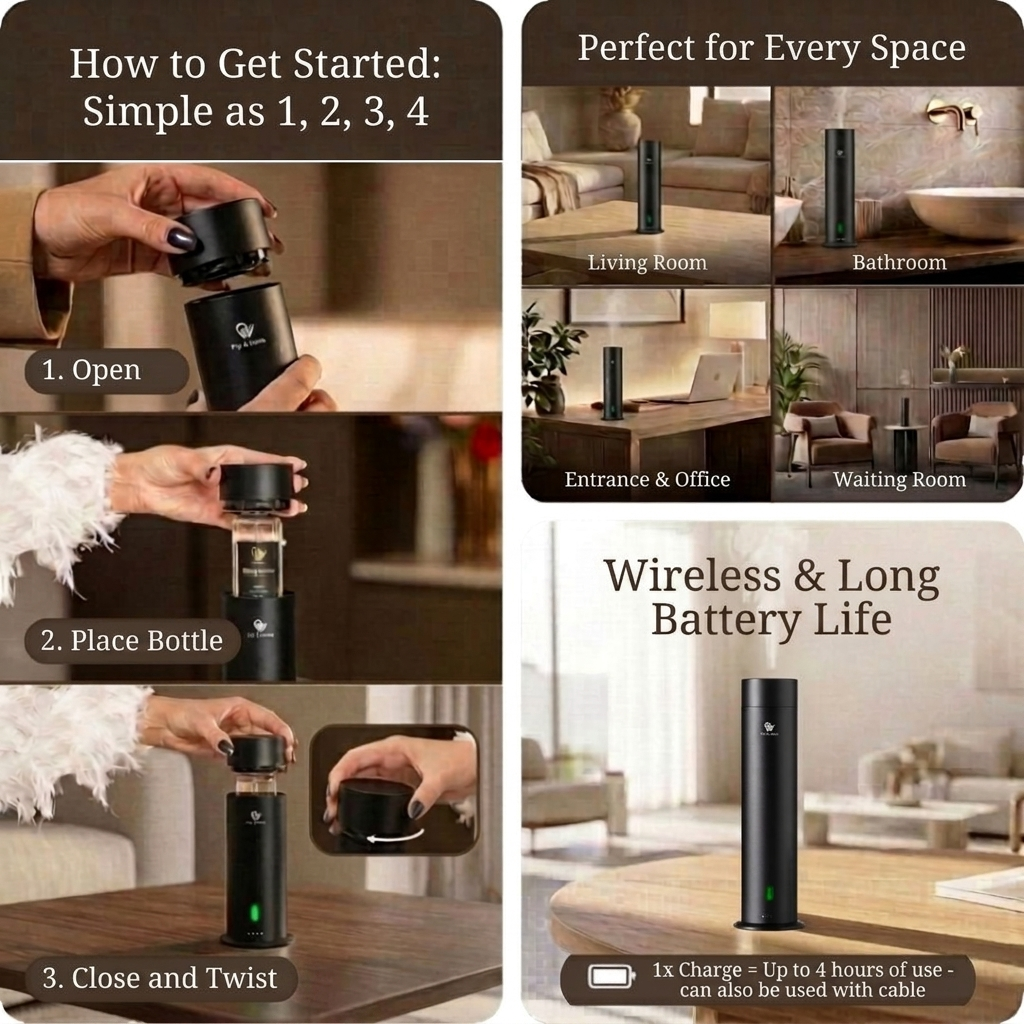
The Pure One was designed for the second category. Available in matte black and brushed silver, covering up to 75 m², and compatible with the full Pip & Wells fragrance oil collection — formulated specifically for cold-air nebulisation so the scent profile you chose is what actually fills the room.
Frequently Asked Questions
Is a waterless diffuser really worth the higher price?
For fragrance performance specifically, yes. A cold-air diffuser delivers the full scent profile at significantly greater coverage than an ultrasonic device, requires no ongoing maintenance, and uses oil more efficiently — meaning the per-month running cost is often lower than it first appears. Over a few months of use, the difference in experience and running cost makes the upfront price easy to justify.
Can I use essential oils in a cold-air diffuser?
Cold-air diffusers are designed for fragrance oils formulated for nebulisation. Standard essential oils vary in viscosity and can produce inconsistent results or cause build-up in some devices. The Pip & Wells fragrance oils are engineered specifically for cold-air diffusion — they atomise cleanly, project evenly, and preserve their full scent profile through the nebulising process.
Do waterless diffusers get clogged?
Quality cold-air diffusers designed for commercial fragrance oils do not clog under normal use. Using very thick or improperly formulated oils can cause build-up in cheaper models. Using oils designed for the device — as Pip & Wells oils are — prevents this entirely.
Are cold-air diffusers louder than ultrasonic ones?
No — modern cold-air diffusers run near-silently on low and medium settings. At maximum intensity there is a soft, barely audible air-pump hum. Most users describe the sound as significantly less noticeable than the bubbling or vibration hum of some ultrasonic models.
Is it safe to run a cold-air diffuser overnight?
Yes — in fact, it is generally safer than running a water-based diffuser overnight. There is no risk of water spillage, no humidity build-up in a closed room, and no mould conditions developing in a tank. Most cold-air devices offer timed intervals specifically suited to overnight use. A low intensity setting for a few hours before sleep is a common and effective routine.
What is the difference between a nebulising diffuser and a cold-air diffuser?
They are the same thing. Both terms refer to a diffuser that uses pressurised air to atomise pure fragrance oil into ultra-fine dry particles without heat or water. "Nebulising" refers to the process; "cold-air" refers to the absence of heat. The Pure One uses this method — also the same technology used in professional hotel scenting systems.
Related: How to Make Your Home Smell Like a Hotel · Is a Waterless Diffuser Safe for Kids and Pets? · How Long Does a Diffuser Oil Last?
Leave a comment
This site is protected by hCaptcha and the hCaptcha Privacy Policy and Terms of Service apply.